

Courses run on two tracks — a youth track and a workplace track — both outcome-driven: less memorizing prompts and passing quizzes, every session ships a deliverable you can actually use; graduation is judged by real behavior, not by exam scores.
Each session produces one deliverable; theory : practice = 2 : 8; prompts are only the starting point — the real work is composing, orchestrating and verifying.
Kids have no shortage of AI-powered toys, and professionals have no shortage of "I tried it once" stories. What's missing is the ability to turn AI into a genuine assistant — even a member of the team. We'd rather start with the boundaries: where it breaks down, and which steps still need a human to sign off. You only dare to delegate when you know exactly where the line is. The problem isn't the tool; it's that no one ever taught you how to hand over a whole piece of work, end to end.
Ages 10–18, no prior experience. From "playing with AI" to "building things" — every level leaves with a piece of work. 26 sessions total, sold by level.
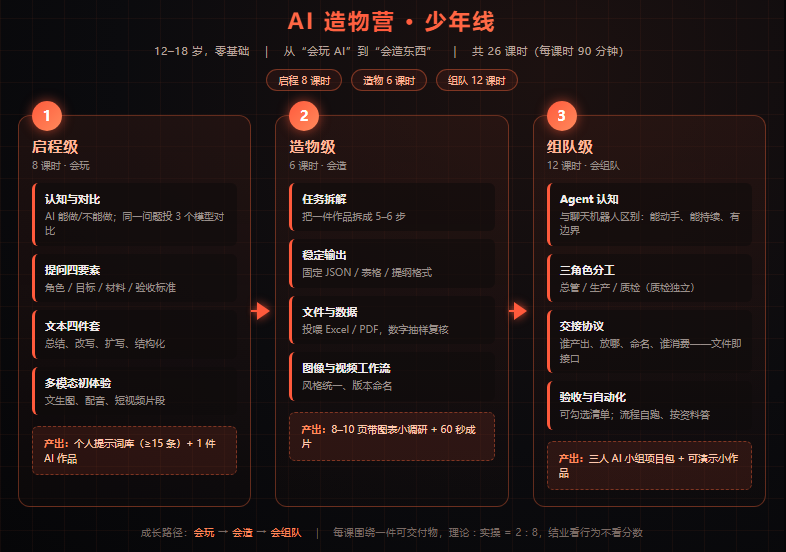

Feed the same question to 3 models and compare; master the four elements of a good prompt (role / goal / material / acceptance criteria); the text four-piece (summarize, rewrite, expand, structure); first taste of multimodal (text-to-image, voice-over, short video clips).
Task decomposition and stable output (fixed JSON / table / outline); feed Excel / PDF and spot-check the numbers; data to expression (charts, pages, true proportions); image and video workflows (consistent style, version naming).
Understand the difference between an Agent and a chatbot; rehearse the manager / producer / QA trio (QA must be independent); use "file as interface" for handoffs; turn "something feels off" into a checklist you can tick; build automation and a knowledge base.
Adults who have used AI but not deeply. From "can use AI" to "can hand the work off" — 26 sessions total, sold by level.
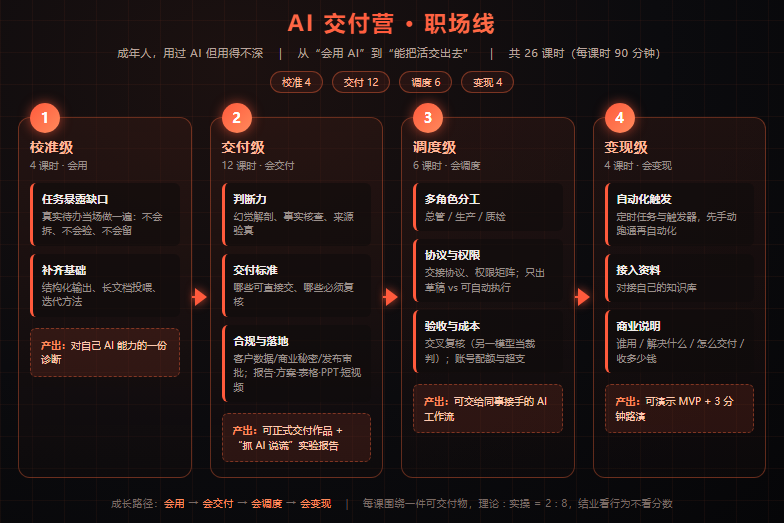

Run a real to-do task on the spot to expose three gaps: can't decompose, can't verify, can't retain; fill in structured output, long-document feeding and iteration methods.
Judgment (hallucination anatomy, fact-checking, source verification); delivery standards (what can be handed off directly, what must be reviewed); compliance (client data, trade secrets, external-publish approval); break real work into steps and deliver step by step.
Multi-role division (manager / producer / QA); handoff protocol and permission matrix (what can only draft, what can auto-execute); acceptance criteria and cross-check (use another model as judge); cost and account management.
Scheduled tasks and triggers (run manually first, then automate); connect your own knowledge base; write a one-page business brief (who uses it / what it solves / how to deliver / what to charge).
Each level comes with a capability checklist ("can … / can … under … conditions"), ticked by the coach plus self-assessed by the learner; the graduation piece is a workflow someone else can reproduce step by step, plus a manual. No prompt-recitation exam, and we do not call it an "official certification."
Tell us the role (or age) of the learners and the problem you want solved, and we'll first sketch a course outline direction.